



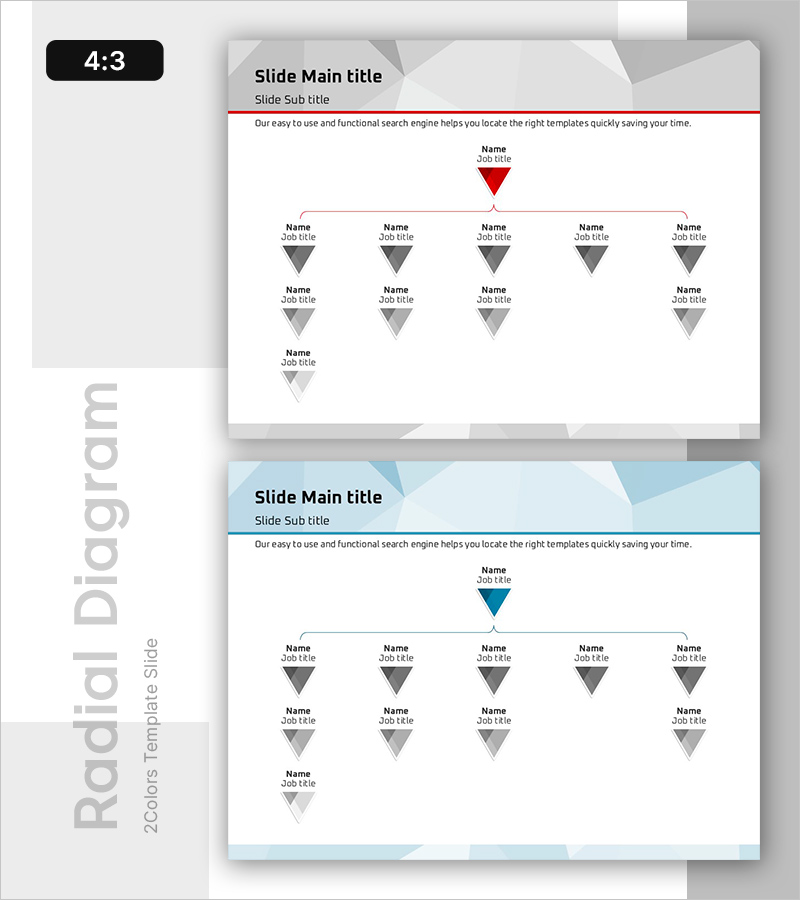
Polygonal Pattern PowerPoint Organization Chart – Clear Hierarchy Distinction
RB0800027_4
- Last Update 03/23/2025
- File Size 0.4MB
- # of Slides 2
- File Format PPTX
- Slide Ratio 4:3
- Color
Keywords
About the Product
A tree-structured organizational diagram PowerPoint slide that clearly presents hierarchical relationships. The red triangle node at the top branches into five levels of gray triangle nodes, intuitively displaying the organizational structure and reporting lines. The 2-slide set features a gray-tone background on the first slide and a light blue background on the second, accommodating various presentation scenarios. Each node includes editable text areas for job titles and department names, making it immediately ready for use in business presentations.
Usage Points
-
Main Usage
Visualizes organizational hierarchy and reporting relationships clearly and effectively. Designed to show the chain of command from executives to staff at a glance, ideal for company introduction presentations and organizational restructuring explanations.
-
How to Use
Edit the text areas in each triangle node to input job titles, department names, and employee names matching your actual organizational structure. Node colors and sizes can be freely adjusted, and nodes can be added or removed as needed.
-
Recommended For
HR professionals, executives, managers explaining organizational changes, new employee trainers, and marketing teams preparing company introduction presentations. Particularly useful for internal communications in companies with clear organizational size and hierarchy.
-
Slide Structure
2-slide set. First slide features gray background with 1 red top-level node, 5 gray second-level nodes, and 4 nodes across levels 3-5, totaling 10 nodes. Second slide uses light blue background with identical structure. All nodes are connected by lines clearly showing hierarchical relationships.
Related Products
-
Global Corporate Vision and Goals Diagram
#Company Introduction #Business Vision and Strategy #Diagram
-

Expert Profiles Overview at a Glance
#Market and Competitor Analysis #Customer Success Stories #Diagram
-
3-Key Expansion Diagram - Emphasizing Business Vision and Strategy
#Business Vision and Strategy #Diagram #Business Strategy
-
Business Direction Semicircle Diagram – Visualizing Business Strategy
#Business Vision and Strategy #Diagram #Business Strategy