



Environmental Protection in Daily Life – Diagram for a Sustainable Future
RJ0600088_10
- Last Update 07/14/2025
- File Size 1.2MB
- # of Slides 2
- File Format PPTX
- Slide Ratio 16:9
- Color
Keywords
- #Content-Based Slides
- #Design-Based Slides
- #Corporate Social Responsibility
- #Diagram
- #Environmental Protection Efforts
- #Sustainability Programs
- #Cluster
- #Closed Cluster Diagram
- #16:9
- #closed diagram PowerPoint
- #3-item circular diagram slide
- #environmental protection slide template
- #sustainability diagram PowerPoint
- #corporate social responsibility PPT slide
About the Product
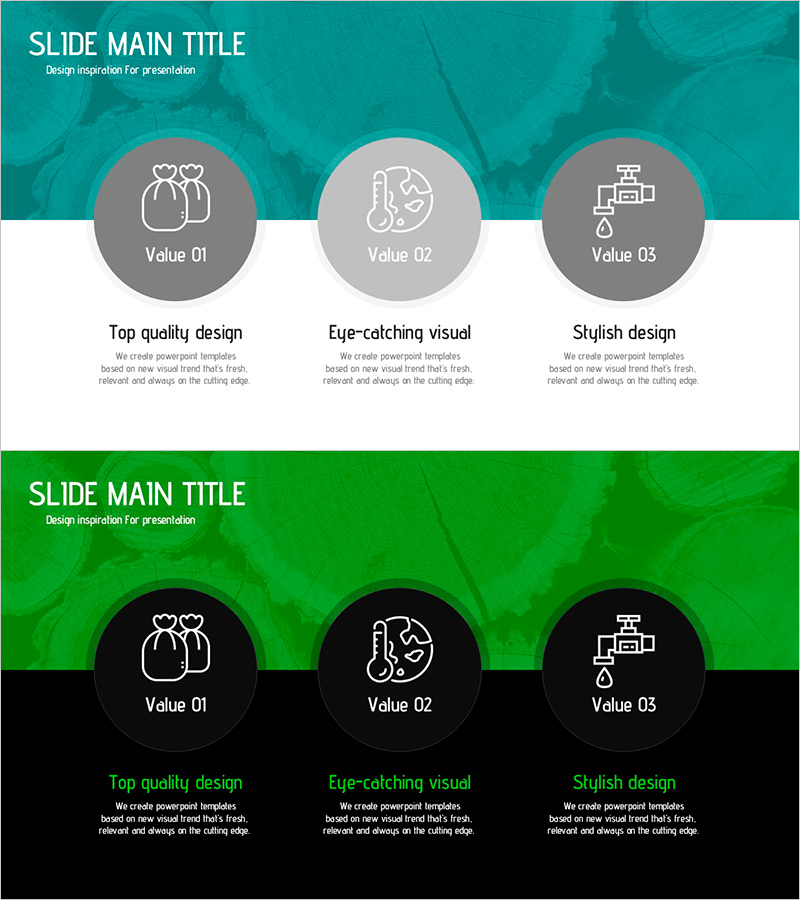
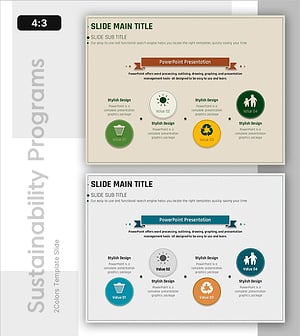
A 3-item closed-form diagram PowerPoint slide that visualizes sustainability and corporate social responsibility. Three circular nodes are arranged on a teal background, each containing environmental protection icons (people, earth, construction). The contrast between white text areas and gray circular nodes creates clear information hierarchy. Two color variations (teal and green) are provided to match presentation themes and brand guidelines. This presentation template is ready to use for environmental policies, sustainable business reports, corporate social responsibility disclosures, and related presentations.
Usage Points
-
Main Usage
Presents three core values—environmental protection, sustainability, and social responsibility—with equal emphasis in a closed-form structure. Effectively communicates concepts where each item is independent yet integrated within the overall context. Optimized for ESG management presentations, environmental policy briefings, and corporate social contribution activities.
-
How to Use
Enter item names and descriptions in the text areas of each circular node. Icons are fixed but can be recolored if needed. The 2-slide set includes one with a teal background and one with a green background, allowing you to select based on presentation flow. Optimized for 16:9 widescreen format.
-
Recommended For
Environmental officers, sustainability report writers, corporate social responsibility managers, government policy officials, environmental educators, and NGO activists. Particularly useful for presentations requiring balanced representation of three key elements.
-
Slide Structure
2-slide set. Each slide features a title area at the top and three circular nodes at the bottom. Nodes are arranged left to right in sequence, with icons and text input areas inside each node. The closed-form structure has no visual connections between nodes, emphasizing item independence.
Related Products
-
Environmental and Social Contribution Activities – Flow Diagram
#Corporate Social Responsibility #Diagram #Environmental Protection Efforts
-
Environmental Strategy Diagram
#Technical Approach #Corporate Social Responsibility #Diagram
-
Emphasizing Social Responsibility through Environmental Diffusion Diagram
#Product/Service Introduction #Corporate Social Responsibility #Diagram
-
Green Action Campaign Program Slide – Emphasis on Social Responsibility and Sustainability
#Product/Service Introduction #Corporate Social Responsibility #Diagram