



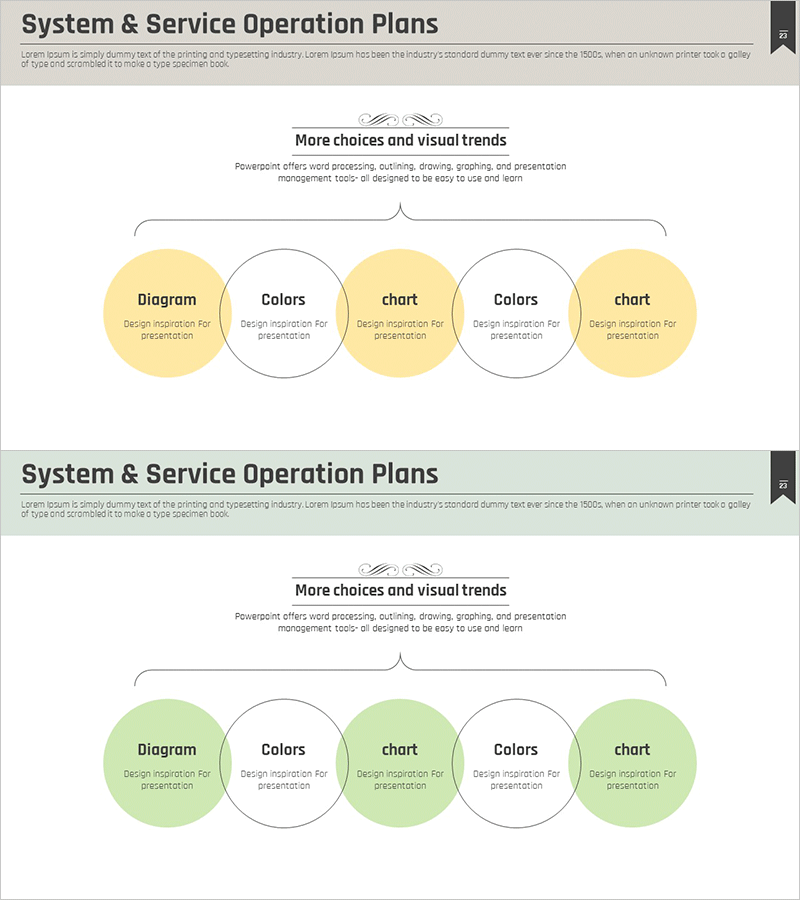
Service Component Diagram – System and Service Operation Plans
RM0200006_22
- Last Update 02/02/2025
- File Size 0.3MB
- # of Slides 2
- File Format PPTX
- Slide Ratio 16:9
- Color
Keywords
- #Content-Based Slides
- #Design-Based Slides
- #Product/Service Introduction
- #Business Management
- #Technical Approach
- #Diagram
- #Features
- #Implementation Plan
- #Cluster
- #Combination Diagram
- #16:9
- #nested diagram PowerPoint
- #service component diagram slide
- #system architecture presentation
- #hierarchical diagram template
- #operation plan PowerPoint slide
About the Product
A nested diagram PowerPoint slide that visualizes system and service operation plans with a five-layer concentric structure. The design uses circular nodes arranged in nested rings to represent hierarchical relationships from core elements to peripheral functions. Yellow and white color contrast clearly distinguishes primary and secondary areas, while each node includes text input fields for easy customization. This slide is ideal for IT technology sections and business management presentations explaining service architecture, system configuration, and operational frameworks.
Usage Points
-
Main Usage
Visualizes hierarchical relationships in system architecture and service operation plans. The concentric structure places core elements at the center and expands peripheral functions outward, making complex system configurations clear and easy to understand.
-
How to Use
Use in IT technology presentations, business management reports, and system design documents to explain service components, operational structures, and technical architecture. Customize each node's text for project-specific needs, enabling representation of organizational hierarchies, process layers, and functional classifications.
-
Recommended For
Recommended for IT engineers, system architects, project managers, and technical leaders presenting system design and operation plans. Effective in technical department reports, business management presentations, and system implementation proposals for communicating complex structures clearly.
-
Slide Structure
Two-slide set featuring concentric node diagrams with five hierarchical layers. Each slide contains one central node, three first-layer nodes, and five second-layer nodes, with alternating yellow highlight nodes and white secondary nodes to visually distinguish information hierarchy.
Related Products
-
Partnership Business Operation Plan Slide
#Product/Service Introduction #Business Management #Technical Approach
-
System Operation Plan Schedule Slide – Efficient Business Management
#Product/Service Introduction #Business Management #Technical Approach
-

Photography Business Operation Plan – Roadmap to Success
#Product/Service Introduction #Business Management #Technical Approach
-
Mobile System Characteristics Configuration Diagram – Visualization of Service Operation Plans
#Product/Service Introduction #Business Management #Technical Approach